Pages

Powered by Blogger.

Friday, 29 November 2013

Planning for Your First Day at School


PREPARE YOUR CLASSROOM
Your classroom will be your home-away-from-home for the next nine months. You'll want it to reflect your personality, your educational philosophy, and your goals for your students. How do you do that? Consider some of these suggestions from veteran teachers.
Prepare bulletin boards. Most of your bulletin boards should be reserved for displaying student work. Simply cover the surfaces with butcher paper or a sturdy fabric and add a title and appropriate graphic. Depending on the grade level of your students, you might want to designate one bulletin board as a calendar board, which will remain constant throughout the year. Elementary and many middle school students also enjoy a student-of-the-week bulletin board. (To get the ball rolling, start with an autobiographical bulletin board of yourself!) For older students, consider setting aside a section of a bulletin board for posting the day's schedule, objectives, class assignments, homework, and upcoming events. Another section of the same board could hold a running assignment log and a handout folder (for students who are absent). For additional bulletin board ideas, check out the Education World article Your Search for Bulletin Board Ideas Is Over!
Set up the room. Desks and activity centers can be arranged in a number of ways, depending on your individual teaching style. You'll find some of the most common room arrangements, along with a discussion of the advantages and disadvantages of each, at Creating an Effective Physical Classroom Environment, Teachers Helping Teachers: Classroom Management, and the Education World article Do Seating Arrangements and Assignments = Classroom Management? Assign seats, at least initially. It will help you learn students' names, establish mutual respect, and maintain classroom control.
Obtain student supplies. Depending on the grade level of your students, you may need paper, pencils, crayons, scissors, glue, construction paper, rulers, or calculators. You'll also need textbooks and possibly workbooks. Be sure to count them!
Obtain teacher supplies. You'll probably need (among other things!) pens and markers, a stapler and staples, paper clips, tape, rubber bands, a plan book, a seating chart, hall passes, and attendance and lunch forms.
Post classroom information. Post your name, room number, and the grade or class you teach, both inside the classroom and outside the classroom door. If you have a telephone in your classroom, post important school numbers next to the phone. Include the main office, the nurse's office, and the phone numbers of nearby classrooms.
Although not, strictly speaking, part of preparing your classroom, this is also a good time to:
Review lesson plans. Look over your first day's lesson plans and obtain all necessary materials.
Prepare materials for students to take home the first day. These might include emergency data cards, a school welcome letter, a calendar showing the class specials schedule and upcoming events, a syllabus, and a homework assignment.
Check books out of the school or public library. Start a habit of reading aloud to your students for a few minutes each day, whatever their grade level!

Thursday, 28 November 2013

Planning for Your First Day at School


PREPARE YOURSELF
Although it's not generally a good idea to clutter your classroom with framed family pictures or your collection of ceramic apples, there are a few personal items that can help you make it through the year. They include:
A diary. Take a few minutes at the end of each day to jot down your thoughts and impressions about the day's events. Was there a lesson that went particularly well, or particularly badly? Why? Did a difficult discipline problem arise? How did you handle it? What was the result? What successes did you experience? What compliments did you receive? As the year progresses, the diary will help you identify what works and what doesn't word, and it will help you find alternate strategies. It will also document your growth as a teacher, something you may not recognize otherwise. Who knows? There might even be a book in it!
A personal appointment calendar. Yes, a date book will come in handy for reminding yourself of faculty meetings, PPTs, and scheduled observations. More importantly, it can be used to document the unscheduled events that crop up during the day, and often come back to haunt you weeks later. You might think you'll never forget the day Darrell's father called to complain about your discipline policies (the first time!), or that Tamika's mother stopped in to request a speech evaluation, or what you did when Patrick bloodied Jose's nose on the playground. But you will! Jot it down immediately in your date book. And keep the date book in, not on, your desk!
A personal survival kit. Store (out of reach of students!) a personal teacher survival kit. Include such items as a small sewing kit, safety pins, bandages, suntan lotion, change, snacks, tea bags or coffee singles, bottled water, breath mints, tissues, hand sanitizer, a spare pair of pantyhose (if appropriate!), sneakers and socks, a scarf and gloves, and any other items that will make bad days and minor catastrophes a little easier to deal with. None of those things are absolutely necessary to your success as a teacher, of course, but having them handy will make your life a lot less stressful.
A sturdy canvas bag to keep it all in.
PREPARE THE WAY
Confidence breeds competence. You'll feel a lot better about facing that first day of school if you take the time to become familiar with the school and with the people you'll be working with. Before school starts:
Familiarize yourself with the school building and grounds. Sure the principal took you on a quick tour, but how much did you absorb, or remember? Take the time before school starts to retrace your steps. Locate the bathrooms (not just the one closest to your classroom!), the gym, the cafeteria, the media center, and the nurse's office. Note where they are in relation to your classroom. Ask where resource classes are held. Find the audio-visual equipment and supply closet and ask about checkout procedures. Take notes or draw yourself a map.
Visit the school Web site. A school Web site can provide valuable information about the school and community, as well as insight into what's expected of students and teachers.
Review school policies and procedures. Ask about any procedures that are unclear. Learn the reasons for any policies that don't seem to make sense. Every school has its own history and problems. You'll be better equipped to follow policies and procedures correctly if you understand the reasoning behind them.
Make friends with the school support staff. They're the best friends a new teacher can have. Introduce, or re-introduce, yourself. Remember names. Ask about attendance and lunch count procedures, if you're not sure about them. Find out how to get an e-mail address. Make it clear you expect to make mistakes at first and that you know they might be inconvenienced. Ask how you can make their lives easier. Bring doughnuts!
Make a friend. Choose a teacher at your grade level or in a nearby classroom and ask if he or she would be available to answer questions or give friendly advice during the first few weeks of school. Let that teacher know that you're open to suggestions and eager to learn.

Wednesday, 27 November 2013

Planning for Your First Day at School part-1

Planning for Your First Day at School


On the first day of school, the secret to success is in the planning, not the pedagogy. How's your back-to-school planning going? Have you forgotten anything? Our checklist can help! Included: Online resources for a variety of back-to-school planning needs, including welcome letters, bulletin board ideas, and back-to-school activities.
It's official. You're a teacher! You aced all your education courses, know the subject matter backward and forward, can rattle off the names and philosophies of dozens of educational theorists, and achieved a pretty respectable score on the state certification exam. You finally have an actual job and an official class list. There's only one problem. The first day of school is drawing near and you have no idea what to do. Are you really ready to face that first terrifying day?
The secret to success in any new endeavor is planning. But for this particular endeavor, don't just plan, over plan. Don't just prepare, over prepare. Don't just write enough lessons plans to fill one class or a single day. (They never do!) Write more than enough!
When it comes to planning ahead, of course, the secret to success is in the details. Use the checklist below to help you with any details you might have overlooked in planning for your first day at school as the teacher.

Tuesday, 26 November 2013

Starring: Sandy Hopkins


"We started in November, recalled physical education teacher Sandy Hopkins, and very soon many students and their parents were asking me about it. Later, when my students reflected about the activities in writing, their comments were all on the line of, It was so fun, I did not even know I was even working out,
What is causing the renewed interest in Hopkins' classes? Electronic games! The one-time archenemies of physical fitness, today's high-tech game systems actually can get kids excited about physical activity.
Hopkins first discovered the games use in physical education programs through published articles, but what convinced her to bring the games into her classes was watching her own son and his friends -- who are about five years older than her students -- play the games at home.
"I noticed how much my son and his friends enjoyed the games and how much physical exercise they were getting," Hopkins told Education World. "I thought the games were something my students would enjoy too, so I started pursuing grants to pay for them."
Today, thanks to a grant from an educational foundation at her school that supports innovative teaching ideas in the classroom, Hopkins' students play their way to physical fitness with "Dance, Dance, Revolution" and "EyeToy" for Sony's PlayStation 2.
Hopkins operates the games as a station, with 3-4 screens and dance mats. Six students typically use the station at one time, and those who are waiting to play use practice dance mats she has created out of carpets and tape. Jump ropes or stationary bikes are sometimes provided at the station as well. Every student is expected to remain active during the entire period.
Delaware Trail Elementary also uses the games for behavioral rewards with students. If selected students from the Brownsburg, Indiana, school have a good day or week, they may have dance or play time with the systems, which is supervised by the school counselor.
"Once I started, I found these systems easy to facilitate," reported Hopkins. "Of course, the younger the students, the more you have to help. The kiddos loved the activities and were excited when they saw the games. I was most surprised by how much the underactive students and those not so easily motivated loved the games." That is evident when Hopkins' less physically active students take positions at the game stations, sweat, and enjoy themselves so much they are reluctant to leave the activities.
With "Dance, Dance, Revolution," Hopkins selects the workout mode and chooses a song for her students. Hopkins recommends the Disney Channel edition of the game because it is age appropriate, and her students respond favorably to the songs and characters. Hopkins currently is investigating the benefits of the Nintendo WII, which wasn't available at the time of her initial purchase.
"Be patient and try the systems at home first to get accustomed to them," she advises oth

Monday, 25 November 2013

Starring: Angie Malley


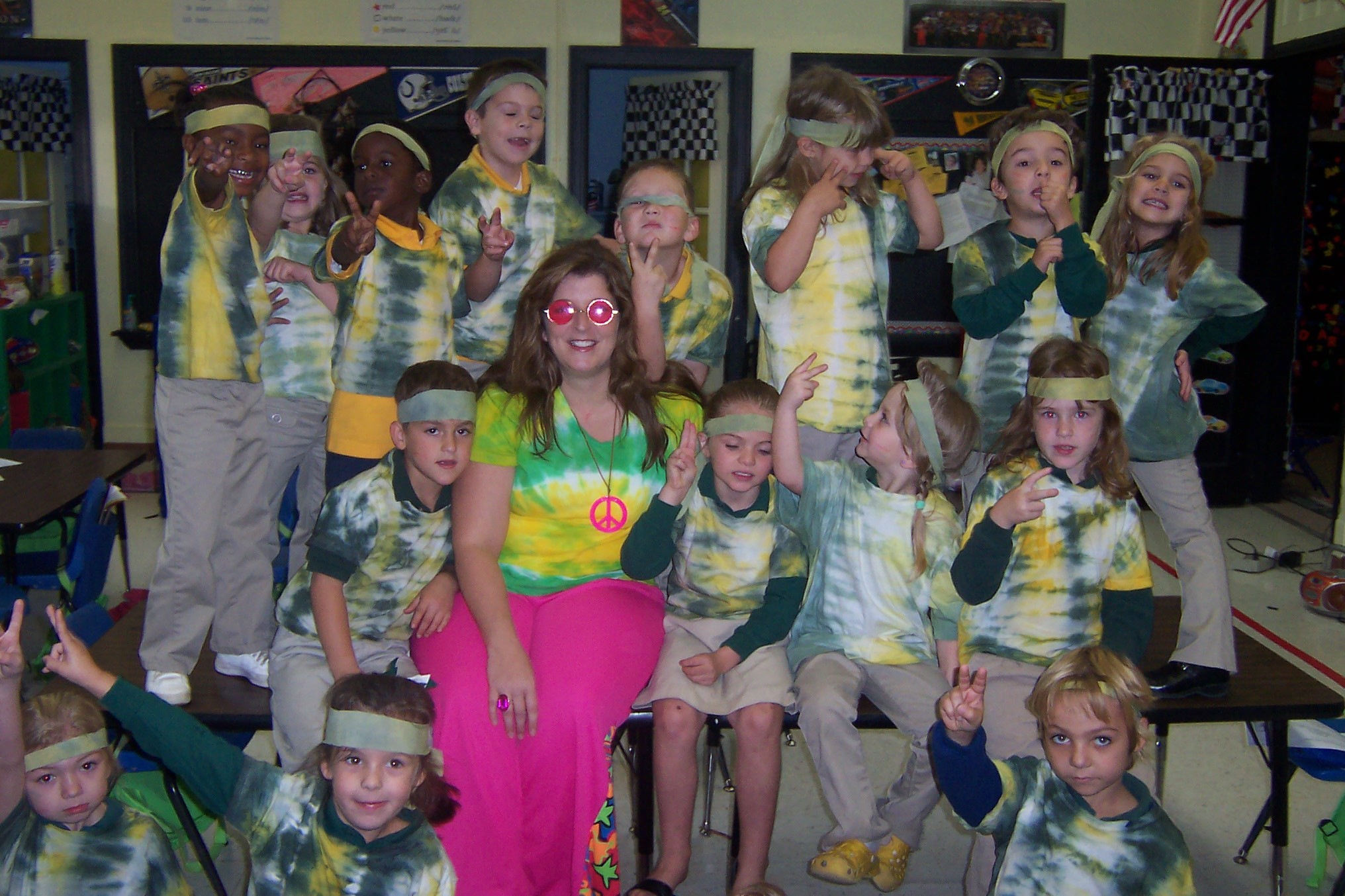
Far-out Teacher Angie Malley still smiles when parents of her kindergarten students tell stories about how the children continue to care for their pet rocks at home, many days after the class's unique 70th Day celebration. This year, Malley's students at Poplarville (Mississippi) Lower Elementary marked the seventieth day of school with a 1970s-themed event.


"Our state curriculum requires that students be exposed to diverse people, culture, and changing environments," Malley told Education World. "To help meet those goals, our school had special celebrations for the 50th day and the 100th day. With 50 days in between those two events, I decided to groove it up a little and celebrate the 70th day of school too. I shared the idea with other members of my team, and they joined in." Malley's kindergarten class is filled with active learners, and she strongly believes that their learning experiences should be fun. She uses special events like 70th Day as incentives, and finds that student participation is higher when they have those occasions to look forward to. After all, who wouldn't be motivated by the prospect of dancing to "YMCA," the 1978 tune by the Village People?


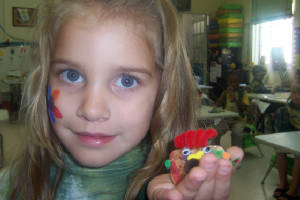
"I researched different inventions and toys from this era," shared Malley. "While wearing tie-dyed shirts, my students rotated through centers that included dancing, making pet rocks, playing the game of Twister, playing with Hot Wheels, and face painting. We talked about how times have changed; however, the students quickly realized that reading, writing, and other school subjects were important then and now."
The event was so much fun that students never noticed they were learning and practicing essential stills. Their excellent behavior is just one reason that Malley says 70th Day is here to stay -- the kids really "dig" it!

Saturday, 23 November 2013

Starring: Nancy Karpyk

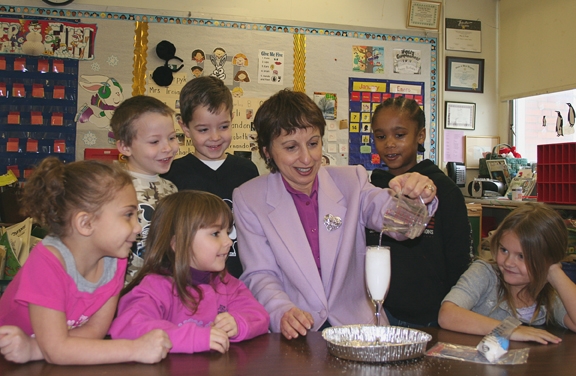
"Children have a natural curiosity about their surroundings," says Nancy Karpyk. "They are fascinated with animals, snow, rainbows, rockets, and even eggs. I realized early in my career that science is like magic. Children are as eager to participate in science demonstrations and labs as they are to be a part of a magician's show."
Science also creates a positive classroom climate, reports the kindergarten teacher from Weirton (West Virginia) Heights School. Her students are anxious to come to school and check on the fish in their aquarium, plants in the window garden, caterpillars in a jar, and potato hidden from light. They love to read non-fiction books, search the Internet for information, and ask questions.
Nancy Karpyk uses science demonstrations and units to capture the attention of her lively kindergartners.
Karpyk's students are so involved in science topics that there is little time for daydreaming. She correlates her science themes -- which set the framework for much of her curricular activities -- to the children's environment. In the fall, they study leaves and pumpkins. In winter, they wonder about snow, penguins, and bears. Spring brings rain, rainbows, and recycling. "Once students are engaged, it is easy to teach data collection, sorting, graphing, and inquiry. It is surprising how kindergarten students begin to understand and use problem-solving skills," shared Karpyk. "Stations are organized around the science themes. Science gives students something real to write about in their journals."
Art projects and other activities in Karpyk's class always reflect the current science focus. Students especially enjoy working with her husband's chemistry students. The high schoolers visit the classroom and help kindergartners make slime, Silly Putty, Shrinky Dinks, and ice cream.
Karypyk realizes that primary teachers rarely have a science budget, so all her demonstrations and activities feature inexpensive household items. She encourages other educators to use science demonstrations to grab students' attention and is working on a book for teachers in grades K-2. The key is to start with a unit that appeals to you, she advises. You never can know how or when a student might be affected by what you teach. For example, Karpyk recently learned that one of her kindergarten science units came in handy during a true emergency.
"The mother of a former student told me that her daughter was jogging and was attacked by a large dog. When she was attacked, she dropped to the ground, rolled into a ball, and protected her neck and face with her arms and hands," Karpyk reported. "The emergency room doctor asked Julie how she knew what to do. She replied that she remembered when I had taught the class about bears and bear attacks. We had also discussed that this would help in the event of a dog attack. The emergency room doctor told Julie that her teacher had saved her life."

Wednesday, 20 November 2013

Teachers, Start Your Engines: Management Tips from the Pit Crew


Professional Development Who said classroom management has to be boring? The editors at Education World offer 20 successful classroom management strategies to get your year off to a great start and keep your classroom running smoothly throughout the entire year. Included: 20 tips for taking attendance, motivating students, rewarding good behavior, and more!


Every teacher knows that the right strategies can make the difference between a calm classroom and a classroom in constant chaos. Teachers in well-organized classrooms in which students know and follow clearly defined rules and routines spend less time disciplining and more time teaching. To help keep your classroom running like a well-oiled machine in the coming year, we've collected some successful -- and often fun -- classroom management techniques from teachers across the country and around the world.

START THE DAY THE RIGHT WAY

Words of welcome. Many teachers have found that the best way to start each day is by greeting students at the door. A warm personal welcome sets the tone for the day and gives the teacher a chance to assess each student's mood and head off problems before they start. One teacher reports that she offers her younger students a choice of three greetings -- a handshake, a high five, or a hug. Their responses, she says, tell her a lot about how each student is feeling that day. A sea of calm. Kids who arrive at school wound up or upset often calm down, experienced teachers say, if classical music is playing as they enter the classroom. Some teachers also turn the lights down low and project the morning's brainteaser or bell ringer activity onto the chalkboard with an overhead projector. That spotlight in the dimly lit room helps focus students' attention on the day ahead.

TIME'S A WASTIN'!

For most teachers, there are never enough hours in a day. Saving even a few minutes of your time can make a big difference in what you accomplish this year. On the move. Increase flexibility in seat assignments -- and make life easier for substitutes -- by creating a visual seating chart. Take a digital photograph of each child in the class. Print the photos and write the student's name at the bottom. Attach a Velcro dot to the back of each photo and to a seating chart created on laminated poster board. The Velcro allows seats to be changed as necessary, and substitutes love being able to easily identify each student.
Make it up. When distributing work sheets, place copies in folders for absent students. At the end of the day, simply label each folder with the absent students' names, and missed work is ready for the students' return.
Would you sign in, please? Avoid time-consuming attendance routines by following the technique used by a Washington teacher. Write each child's name on a strip of tag board, laminate it, and glue a magnet to the back. Each day, post a question and possible answers on a whiteboard. Students can "sign in" by placing their magnets in the appropriate answer column. Questions might be personal, such as "Do you own a pet?"; trivial, such as "What was the name of the Richie's mother on Happy Days?"; or curriculum related.
Make attendance count. If you prefer to take attendance individually, make it meaningful. Instead of calling out students' names and waiting for them to say "Here," ask each student a quick question related to the previous day's work.

WHERE'S MY PENCIL?

The average teacher spends $400 a year of his or her own money on classroom supplies. At that price, holding on to the supplies you have can be a priority. But who has time to search every child's backpack for borrowed pencils? These teacher-tested techniques can save your money and your sanity. Forget-me-nots. A South Dakota teacher uses floral tape to attach large silk flowers to the tops of the pens and pencils she keeps for student use -- turning the writing tools into hard-to-forget flowers. The "flowers," kept in a vase on the teacher's desk, also serve to brighten up the room.
Do you have a shoe to spare? If you find the flower pens cumbersome, try the technique used by an Iowa teacher. She allows students who forget their pens or pencils to borrow one -- if they give her one of their shoes. Students only get the shoe back when they return the pencil. No half-shod student ever forgets to return that borrowed pencil!
Neither a borrower nor a lender be. This tip comes from one of Education World's regular contributors. It developed, says Brenda Dyck, because she grew tired of dealing with students who came to class without pencils, texts, or homework. In Dyck's classroom, each student starts the term with 100 points toward a "Preparedness Grade." If they come to class with a pen or pencil, textbook, and completed homework, they get to keep the 100 points. Every time they show up without any one of those things, however, one point is subtracted from their grade. The students' report cards include a category called "preparedness," which counts toward their final grade. "For some reason, keeping their 100 points is quite motivational for my middle school students," Dyck says. "Unprepared students have become almost nonexistent in my classes. I've been amazed!"

MOTIVATION

Discipline problems, experienced teachers say, can be greatly reduced if students are properly motivated -- to come to school, to arrive on time, and to work diligently while they're there. Some simple techniques can make doing the right thing even more fun than misbehaving. Round 'em up. First you have to get them there. Discourage absenteeism by randomly choosing one student's desk or chair each day and placing a sticker beneath it. The student who arrives to find the sticker under his or her seat gets to choose a small prize. If the student is absent, of course, the prize is forfeited. (And the other students are always happy to pass along that news!)
Don't be late. A teacher in California discourages tardiness by inviting students who are not in their seats when the bell rings to go to the front of the room and sing a song. "Sometimes we have a duet, a trio, and even a choir," she says. "It puts a smile on everyone's face and starts the class in an upbeat way. And no one has been more than 30 seconds late since I started using this technique!"
Can you spell homework? A simple group motivation technique can be helpful in encouraging students to complete their homework. Every day all students in the class complete their homework assignments, write one letter of the word homework on the chalkboard. When the word is completed, treat the entire class to a special reward.
Not a minute to waste. Do you find yourself losing precious minutes as you attempt to change activities, line up for specials, or return from recess? Tell students that they are going to be rewarded for the time they don't waste during the day. Explain that you will give them 3 minutes a day of wasted time. They can use up that time each day or save it up and use it for something special. Agree on something students could do with the "wasted" time and decide how much time they will need to save for that special event. Tell students that as soon as they've saved the required amount of time, they will be able to hold their special event. Each day, give students three minutes. When they waste time during the day, start a stopwatch, time the amount of time wasted, and subtract it from the three minutes. You'll be surprised at how quickly your students learn the value of a minute!
The door swings out. Sometimes it seems as though you have a swinging classroom door -- leading straight to the restroom. How do you determine if those restroom requests are legitimate or just an excuse to leave the room? Stop guessing! You can discourage middle and high school students from asking to leave the room unnecessarily by providing an unwieldy or embarrassing hall pass. Some suggestions: an old wooden toilet seat or a huge stuffed animal.